Fermentation properties of yogurt with fermented broth of Paecilomyces cicadae
Hua Xiong1, Qin-Lan Guan1, Ming-Fu Gong1, 2, Kun-Qi Zhang1, Ming Zhao1, Jing Guo1 and Wan-Yue He1
1 College of Life Sciences, Leshan Normal University, Leshan, 614000, China
2 Plant Resources and Ecology Research Center of southwestern sichuan province, Leshan Normal University, Leshan, 614000, China
*Corresponding author: gongmingfu98@163.com
Abstract. Fermented broth of edible fungus is a product obtained by liquid culture with edible fungus. The yogurt adding fermented broth of edible fungus can promote the growth of lactobacillus in yogurt, increase the total number of lactobacillus in the finished product, give the product special flavor, and have higher nutritional value and new health effects. The changes in pH and lactic acid content during the fermentation, the content of polysaccharides, crude protein, and trace elements, and the changes in the total number of lactobacillus during storage of three types of yogurt, yogurt with fermented broth of Paecilomyces cicadae added (fermented broth yogurt), yogurt with fruit body of P. cicadae added (fruit body yogurt), and yogurt with no flavour added (natural yogurt), were studied. The results indicated that the speed of pH decrease, and increase of lactic acid content of fermented broth yogurt were higher than those of the other two types of yogurt. The lactic acid content of the three yogurts tended to stabilize to a certain time after fermentation. The nutrient content of crude protein, polysaccharide, iron, magnesium, calcium, and zinc of fermented broth yogurt was higher than that of the other two yogurt. During storage, compared with the other two types of yogurt, the total number of lactobacillus in fermented broth yogurt declined more slowly. Fermented broth yogurt of P. cicadae promoted the growth of lactobacillus in yogurt and had high nutritional value.
1. Introduction
Fermented yogurt is a nutrient-rich health food, rich in various organic acids, peptones, peptides, and other trace active substances and active lactobacillus. It can promote the growth of lactobacillus in the human intestine and regulate the balance of the microbial flora in the human intestine. It has many functions, such as intestinal cleansing function, lower cholesterol, prevent elderly cardiovascular disease and other health functions [1].
Since fermented food products are rich in nutrients and are proven to be beneficial to human health [2], more and more researches are focused on fermentation strains [3, 4] and fermentation processes [5, 6]. Yogurt adding edible fungus fruiting body or its extract to fermented can promote the growth of lactobacillus in yogurt, increase the total number of lactobacillus in the finished product, give the product special flavor, have higher nutritional value and new health effects, and enrich the variety of fermented yogurt [7]. At present, the types of edible fungi that use fruiting bodies or their extracts for yogurt fermentation include Flammulina velutipes [8] and Coprinus comatus [9] and so on.
Fermented broth of edible fungus is a product obtained by liquid culture with edible fungus. It has the nutritional elements contained in the edible fungus fruit body, and the production cycle is shorter than of the fruit body, and the nutritional value is higher than of the fruit body. Fermented broth of edible fungus is rich in polysaccharide, which has the functions of immunoregulation, anti-tumor, anti- aging, anti-infection [10, 11]. The protein content and other nutritional components of fermented broth of edible fungus are generally higher than of the fruiting body [12].
Cicada flower [13] is also called cicada, cicada fungus, Cordyceps sobolifera, Hu Chan, etc., and is worm complex formed by an asexual form of Cordyceps cicadae Shing, Paecilomyces cicadae (Miquel) Samson [14, 15] parasitic in Cicada flammata Dist) [16, 17]. Cicada flower is a traditional Chinese medicinal material in China. It has the effects of dispersing wind and heat, calming the eyes, and catching eyesight. It treats children's sky hanging, night crying and heart palpitations, expelling wind and stopping spasm, measles, red eyes, and tears [18]. The corpses (sclerotia) of host insects can be used as medicinal parts [19]. Cicada flowers are mainly distributed in Anhui, Zhejiang, Yunnan, Guangdong, Shaanxi, Jiangxi, Sichuan, etc. [20]. Cicada flowers contain chemical components such as glycogen, mannitol, various alkaloids, proteins, various amino acids, and various trace elements, and the content of sugars and proteins is relatively high [21-27]. Cicada has the effects of enhancing the body's immune system [28-32], suppressing tumors [28-30], improving renal function [36, 37], reducing gall solids and regulating body lipid metabolism, and so on [38, 39]. Although Paecilomyces cicada has initially realized the artificial small-scale cultivation of spore bundles [40, 41], the technology for large-scale cultivation of artificial cicada flower fruit bodies is still immature. Studies have confirmed that the liquid fermented mycelium, artificial cicada flower, and cicada flower fruit body of P. cirrhosa have some differences in the content of each component, but the overall component species are consistent [42-48].
Fermented broth yoghurt of P. cicadae, which made from fermented broth of P. cicadae and commercially available milk powder and fermented by lactobacillus, which overcomed the shortcomings of the long growth period and small amount of the flower body of the cicada. In addition, it can make full use of the nutrition and health effects of the flower body of Cicada, enrich the variety of fermented yogurt, and improve people's healthy living standards. The purpose of this test is to study the fermentation characteristics of fermented broth yoghurt of P. cicadae and provide basis for the development and utilization of cicada flower.
2. Materials and methods
2.1. The strains and ingredients used in this experiment
P. cicadae, Lactobacillus bulgaricus, and Streptococcus thermophilus were provided by the Microbiology Research Laboratory of Leshan Normal University. Fresh fruit bodies of Cicada were provided by the County Agriculture and Forestry Bureau of Leshan City. Milk powder, white sugar, stabilizer, yogurt starter were purchased from the market.
2.2. Medium used in this experiment
Improved PDA culture medium: potato tuber extract 1.0 L, K2HPO4 3.0 g, MgSO4. 7H2O 1.5 g, yeast extract 0.1 g, agar 15.0 g, pH 6.0. The method for preparing potato extract was: the potato was peeled, choped, taken 200 g to 1.0 L water, boil for 30 min, filter, and make up the filtrate to 1.0 L.
2.3. Preparation of fermented broth of Paecilomyces cicadae
From the slant surface of the activated P. cicadae, an appropriate amount of mycelium was picked and inoculated into the modified PDA liquid medium, and incubated at 25 °C for 10 d. During this period, observe whether the culture was normal every 12 hours. After the culture was completed, the culture solution was suction-filtered to obtain fermented broth of P. cicadae.
2.4. Manufacture of yogurt
2.4.1. Manufacture of natural yogurt. 25 g milk powder, 120 mL distilled water, 7% granulated sugar, and 5 ‰ stabilizer was added in a sterile yogurt bottle, heated and mixed well, putted in a thermostatic water bath at 80 °C for 20 minutes, removeed, cooled. Then the starter was added in yogurt bottle to mix, incubated for 8 h in a 42 °C incubator, then puted in a 4 °C aseptic refrigerator and cooked for 24 h to obtain the natural yogurt (yogurt with no flavor added.
2.4.2. Manufacture of fruit body yogurt of Paecilomyces cicadae. 150 g fresh fruit bodies of P. cicadae was selected, washed, dried in an oven at 45 °C for 24 h, taken out, crushed in a tissue mill to cicada flower powder, puted in sealed bags for later use.
25 g milk powder, 1% cicada flower powder, 120 mL distilled water, 7% granulated sugar, and 5‰ stabilizer was added in a sterile yogurt bottle, heated and mixed, and putted in a thermostatic water bath at 80 °C for 20 minutes, removed, cooled. Then the starter was added in yogurt bottle to mix, incubated for 8 h in a 42 °C incubator, then putted in a 4 °C aseptic refrigerator and cooked for 24 h to obtain fruit body yogurt of P. cicadae.
2.4.3. Manufacture of fermented broth yogurt of Paecilomyces cicadae. 25 g milk powder, 120 mL fermented broth of Paecilomyces cicadae, 7% granulated sugar, and 5 ‰ stabilizer was added in a sterile yogurt bottle, heated and mixed, and putted in a thermostatic water bath at 80 °C for 20 minutes, removed, cooled. Then the starter was added in yogurt bottle to mix, incubated for 8 h in a 42°C incubator, then putted in a 4 °C aseptic refrigerator and cooked for 24 h to obtain fermented broth yogurt of P. cicadae.
2.5. Detection method of yogurt
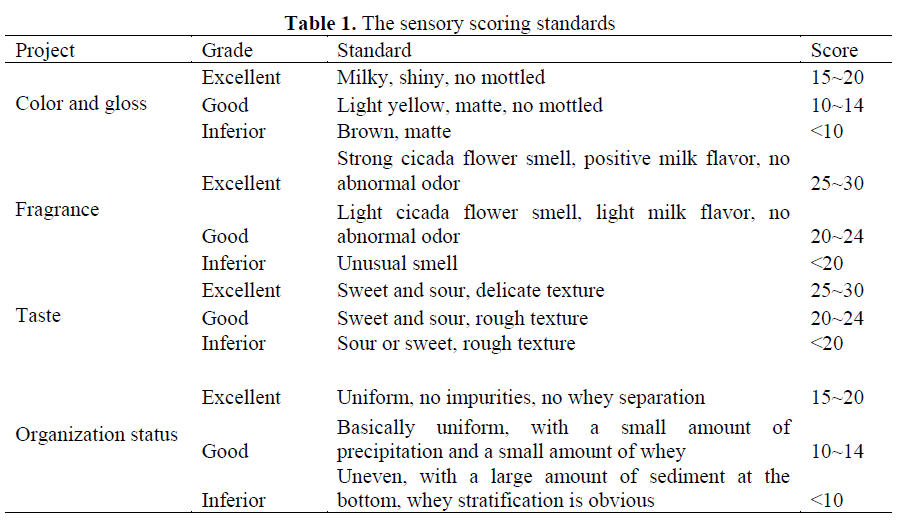
2.5.1. Sensory evaluation of yogurt. Three types of yogurt (natural yogurt, fruit body yogurt of P. cicadae, fermented broth yogurt of P. cicadae) was observed and tasted by fifteen people. Score of sensory evaluation was performed according to the sensory scoring standards (Table 1).
2.5.2. Determination of polysaccharide content in three types of yogurt. The content of polysaccharides in three yogurts was determined by spectrophotometry [49].
2.5.3. Determination of crude protein content in three types of yogurt. The crude protein content of the three types of yogurt was determined by UV absorption spectrophotometry [49], and the protein conversion factor was 6.25.
2.5.4. Determination of five trace elements content in three types of yogurt. The samples to be tested of three yogurt were quantitatively removed and digested, so that the trace elements were changed from organic to inorganic, and the content of five elements of iron, magnesium, calcium, copper, and zinc was determined by atomic analysis spectrometer [50].
2.5.5. Determination of pH during fermentation in three types of yogurt. The pH of three yogurt were determined by a pH meter.
2.5.6. Determination of lactic acid content during fermentation with HPLC method in three types of yogurt. Preparation of mobile phase: 5.0 g of analytical pure ammonium dihydrogen phosphate was weighed, the volume was adjusted to 1 L with ultrapure water, the pH was adjusted to 3.0 with phosphoric acid, and filtered through a 0.45 μm filter membrane.
Preparation of lactic acid standard solution: 330 mg of lactic acid was weighed, dissolved with 5 g / L ammonium dihydrogen phosphate solution and maken up to 100 m L as the standard mother liquor. Then accurately transfer a standard volume of the standard mother liquor to prepare 20%, 40%, 60%, 80% (V: V) standard series, and filter it with a 0.45 μm filter.
Sample preparation: 10 mL sample was placed in a centrifugal tube, adjusted the pH to 4.2 with phosphoric acid, and centrifuged for 10 min at 8000 r / min, and then filtered through a 0.45 μm filter membrane [51].
2.5.7. Determination of microbial indicators in three types of yogurt. The total number of lactobacillus was determined by the plate counting method with reference to the hygienic standard for yoghurt [52]. Coliform bacteria and pathogenic bacteria were determined with reference to food hygiene microbiological examination of milk and dairy products [50].
3. Results
3.1. Results of sensory evaluation
The sensory evaluation results of the sensory evaluation team members was shown in the Table 2.
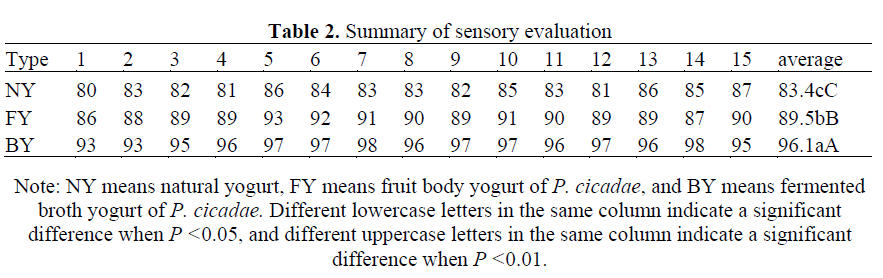
As shown in Table 2, the score of fermented broth yogurt was significantly different from of the fruit body yogurt and natural yogurt. The comprehensive evaluation of fermented broth yogurt has the highest appearance, the best appearance and the best taste, which had great market value (Table 2).
3.2. Determination results of polysaccharides content in three types of yogurt
Determination results of polysaccharides content in three types of yogurt was shown in the Table 3.
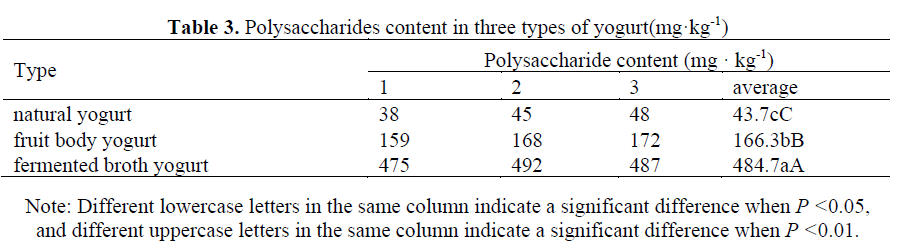
It can be seen from Table 3 that the polysaccharide content of fermented broth yogurt was significantly different from that of fruit body yogurt and natural yogurt, which was far higher than the other two types of yogurt. The polysaccharide content of the fermented broth yogurt was 191.5% higher than that of the fruit body fruit yogurt and 1009.2% higher than the natural yogurt (Table 3).
3.3. Results of determination of crude protein content in three types of yogurt
Determination results of crude protein content in three types of yogurt was shown in the table 4.
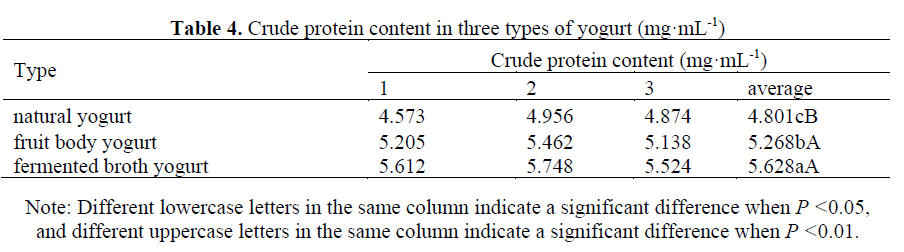
It can be seen from Table 4 that the crude protein content of fermented broth yogurt and fruit body yogurt with the cicada flower fungu was significantly higher than of natural yogurt. The crude protein content of fermented broth yogurt was about 6.83% higher than that of fruit body yogurt, and about 17.23% higher than that of natural yogurt (Table 4).
3.4. Determination results of five elements contents in three types of yogurt
Determination results of five elements contents in three types of yogurt was shown in the Table 5.

It can be seen from Table 5 that the content of iron, magnesium, calcium, copper, and zinc in fermented broth yogurt was higher than that of natural yogurt, and it was far higher than that of fruit body yogurt except copper (Table 5).
3.5. Changes of pH during fermentation of three types of yogurt
Changes of pH during fermentation of three types of yogurt was shown in the Table 6.
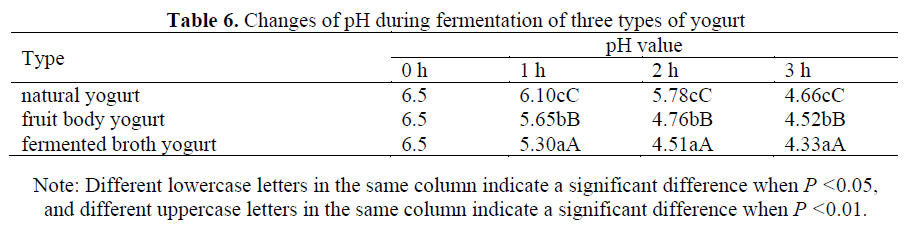
It can be seen from Table 6 that during the fermentation process, the pH value of fermented yogurt decreased significantly faster than the other two types of yogurt (Table 6).
3.6. Changes of lactic acid content during fermentation of three types of yogurt
Determination results of five elements contents in three types of yogurt was shown in the Table 7.
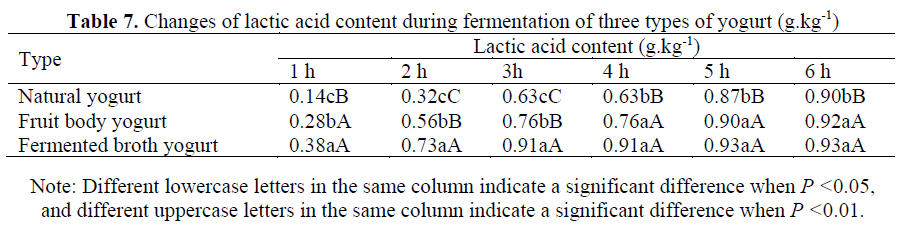
It can be seen from Table 7 that within 3 hours of fermentation, the production rate of lactic acid from fermented broth yogurt was significantly higher than that of the other two types of yogurt. However, after 6 hours of fermentation, the amounts of lactic acid produced by the three types of yogurt tended to be almost the same (Table 7).
3.7. Measurement results of microbial indicators during storage of three types of yogurt
Determination results of the total number of lactobacillus during storage in three types of yogurt was shown in the Table 8.
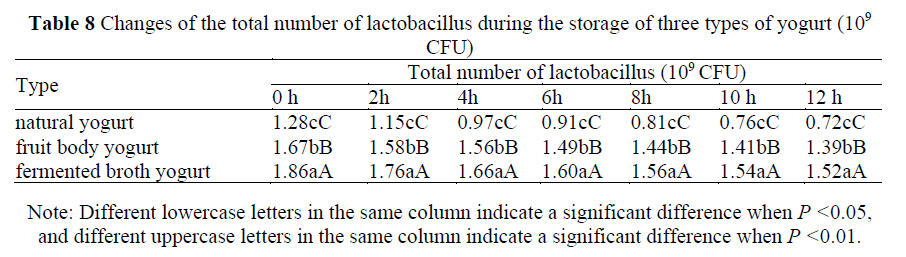
It can be seen from Table 8 that during the storage period, the total number of lactobacillus in fermented broth yogurt was significantly higher than that in fruit body yogurt and natural yogurt. The coliform counts of the three yogurts were lower than the national standard (≤90 MPN / 100 g), and no pathogenic bacteria were detected.
4. Discussion
The nutrition of natural yogurt mainly came from the raw milk powder and the products of fermentation. The content of polysaccharides, crude protein, and trace elements such as iron, magnesium, calcium, and zinc was small. In addition to milk powder and fermented products, the nutrition of cicada fruit body yogurt also originated from cicada fruit body. Therefore, the content of polysaccharides, crude protein, iron, magnesium, calcium, zinc and other trace elements in the fruit body of cicada was higher than that of natural yogurt. The nutritional content of fermented broth yoghurt was much higher than fruit body yoghurt. The main reason was that the nutrient content of the fermented broth of Paecilomyces cicadae was higher than that of fruit body of Paecilomyces cicadae. And by evaluating the senses such as color, flavor, taste, and tissue state, the score of fermented broth yoghurt was relatively high.
Compared with the cicada fruit body, fermented broth of P. cicadae had a short production cycle, can be produced on a large scale, and had the advantages of low cost and high value. Therefore, the production cycle of fermented broth yoghurt was shorter than that of fruit body yoghurt, and the cost was lower.
It can be seen that no matter from the nutritional aspect, the sensory evaluation aspect, or the production cycle, the production cost aspect, fermented broth yoghurt had the advantage. The fermented broth yogurt was a new type of health-care yogurt suitable for consumption by the general public and had a broad market prospect.
5. Conclusion
The speed of pH decrease, and increase of lactic acid content of fermented broth yogurt were higher than those of the other two types of yogurt. The lactic acid content of the three yogurts tended to stabilize to a certain time after fermentation. The nutrient content of crude protein, polysaccharide, iron, magnesium, calcium, and zinc of fermented broth yogurt was higher than that of the other two yogurt. During storage, compared with the other two types of yogurt, the total number of lactobacillus in fermented broth yogurt declined more slowly. Fermented broth yogurt of P. cicadae promoted the growth of lactobacillus in yogurt and had high nutritional value.
Acknowledgments
The work was supported by the scientific research fund of the Sichuan provincial education department (Grant NO: 15TD0026), and National University Students Innovation and Entrepreneurship Training Program (Grant NO: 201810649042).
References
[1] Kibum P and Sukheung O H 2007 Bioresource Technology 98 1675.
[2] Ahsan S, Zahoor T, Shehzad A and Zia MA 2019 J. Anim. Plant Sci. 29 674.
[3] Afzaal S, Hameed U, Ahmad N, Rashid N and Haider MS 2019 Pak. J. Zool. 51 1145.
[4] Chiu HH, Zou SY, Zhu D and Li XL 2019 Int. J. Agric. Biol. 22 967.
[5] Zhao Y, Huang JH, Liao AM, Hou YC, Yang CR, Lv X, Hui M and Zhang XS 2019 Int. J. Agric. Biol. 22 1599.
[6] Xie CZ, Zeng HY and Qin LK 2019 Int. J. Agric. Biol. 21 757.
[7] Li X and Zhao Z 2006 J. Anhui Agric. Sci. 34 5033.
[8] Li F L, Zhang L L and Zhuang W 2005 Beverage & Fast Frozen Food In dustry 11 16.
[9] Wang L S 2006 Food Research & Development 27 83.
[10] Kaneko Y, Chihara G and Taguchi T 1989 Int J lmmunother 4 203.
[11] Kimura Y, Iijima S, Kato T 2003 Gem To Kagaku Ryoho 11 1791.
[12] Huo P 2003 J. Zhejiang University of Science and Technology 15 94.
[13] Chen Z A, Liu G Y and Hu Y Y 1993 Chinese J. Mycology 12 138.
[14] Wei Y L, Yang M F, Zou X and Liu A Y 2014 Guizhou Agric. Sciences 42 142.
[15] Dong C,Guo S and Wang W 2015 Mycology 6 121.
[16] Chen L and Song J M 2009 China J. Traditional Chinese Medicine and Technology 16 159.
[17] Paterson R R 2008 Phytochemistry 69 1469.
[18] Guangdong Chinese Medicine Journal Editorial Board 1996 Guangdong J. Traditional Chinese Medicine Vol 2 version 2 (Guangzhou: Guangdong Science and Technology Press) P 816.
[19] Jiang N, Gao D W, Lin J S and Ma J X 2017 Jiangsu Agric. Sciences 45 11.
[20] Song B, Lin Q Y, Li T H, Li J J and Luo D X 2006 Bacterial Research 4 10.
[21] Chen Z A. 1991 Chinese J. Mycology 10 280.
[22] Xing K K, Shi P, He Z Y, Liu Y and Chen S J 2018 J. Anhui Agric. Sci. 46 162.
[23] Gao Z P, Lu J Q, Chen G Y, Jiang P F and Li J 1993 Research and Development of Natural Products 5 86.
[24] Yu Y, Gu L, Chen Q Q and He Y L 1997 J. Hangzhou Teachers College 6 61.
[25] Song Y L, Song J M and Yan J W 2000 New J. Traditional Chinese Medicine and Clinical Pharmacology 11 367.
[26] Zhu Z Y,Song J S J and Xin J X J 2001 Chinese J. Modern Applied Pharmacy 18 441.
[27] Yu SJ, Chai X Y and Fan M Z 2015 Food and Machinery 31 155.
[28] Kim H S, Kim J Y and Ryu H S 2011 J Med Food 14 847.
[29] Xu Z, Yan X and Song Z 2018 Int J Biol Macromol 117 610.
[30] Takano F, Yahagi N and Yahagi R 2005 Int Immunopharmacol 5 903.
[31] Song J M, Wang H F, Luo J, Shan K K and Li Y X 2018 Chinese J. Nuclear Agric. 32 1977.
[32] Jin L Q, Lu J X, Yuan Q, Jin J and Chen X F 2001 J. Wenzhou Medical College 31 344.
[33] Wang Q and Liu Z Y 2004 Chinese Traditional Herbal Drugs 34 469.
[34] Lu B Z, Jiang Z M, Mu H Z, Hou G L and Wang C L 2006 China J. Traditional Chinese Medicine and Technology 13 328.
[35] Chen A H, Shao Y, Li J W, Jiang Z Z and Chen H W 2015 Food Science 36 194.
[36] Wang L and Chen Y P 2006 J. Traditional Chinese Medicine 19 9.
[37] Zhu R, Chen Y P and Deng Y Y 2010 Shanghai J. Traditional Chinese Medicine 44 4.
[38] Yang J Z, Jin L Q, Lu J X, Yuan Q and Jing J 2004 Chinese J. Gerontology 24 343.
[39] Feng L C 2002 J. Shanghai Institute Technology (Natural Science Edition), 2 125.
[40] Hu H Y, Zou X, Luo L, Liu A Y and Liang Z Q 2009 China J. Chinese Materia Medica 34 2140.
[41] Li Z, Liu A Y and Jin D C 2010 J. Hebei University (Natural Science Edition) 30 682.
[42] Chen X Q, Yang Y and Yang S L 2015 Edible fungi 37 10.
[43] Li R X, Hu F, Chen A H and Fan M Z 2007 J. Xuzhou Institute of Technology 22 23.
[44] Ge F, Xia C R, Li C R, Din T, Shao Y and Fan M Z 2007 J. Mycology 26 68.
[45] Liu Se Q, Wen L, Xia M and Jiang L 2008 Anhui Agric. Sci. 36 429.
[46] Teng Y, Guan Z H and Song Y L 2012 J. Zhejiang University Traditional Chin. Med. 36 1123.
[47] Zhang H X, Gao X H, Chen W and Huang X H 2012 J. Edible Fungi 19 59.
[48] Zhang Z W,Tan J D,Li X H,Chen G H, Liu T and He D L 2019 Chemistry and Bio-engineering 36 12.
[49] The National Pharmacopoeia Committee 2005 Pharmacopoeia of the People's Republic of China (Beijing: Chemical Industry Press)
[50] Zhu J P 2006 Quality inspection of milk and dairy products ( Beijing: China Metrology Press)
[51] Zhou J Z, Dong M S, Jiang H H, Wu G H and Shen M F 2006 Food Science 27 29.
[52] Liu Y C 2006 Food Inspection Technology (Microbial Section) ( Beijing: China Light Industry Press)